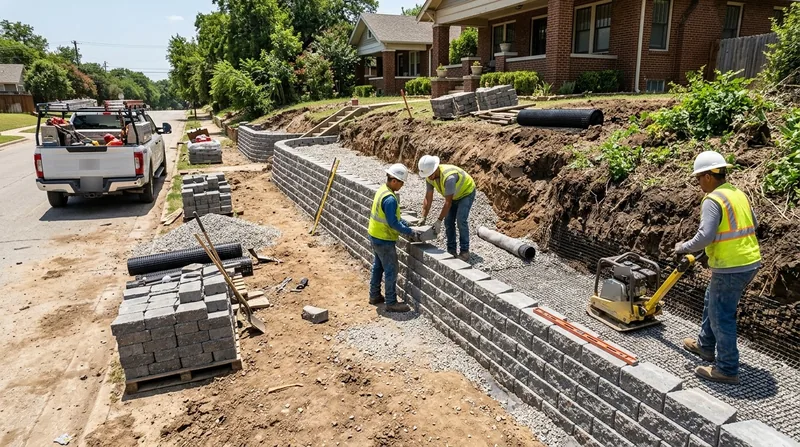




Block and segmental retaining walls in Fort Worth are engineered solutions built from interlocking mortarless blocks, reinforced with geogrid, that handle the demanding soil and weather conditions across our region. From the clay-heavy yards of Tanglewood and Ridglea to the limestone bluff properties overlooking the Trinity River in Mistletoe Heights and Rivercrest, segmental block walls deliver durability and design flexibility that timber and poured concrete often cannot match. Fort Worth's expansive black clay shrinks hard in summer drought and swells aggressively after spring thunderstorms, putting relentless pressure on retaining structures. Segmental block systems absorb that movement better than rigid alternatives, and their mortarless construction allows drainage that prevents the hydrostatic buildup that collapses sagging landscape timber and railroad tie beds from the 1970s and 1980s. We install, repair, and replace segmental retaining walls using Allan Block, Versa-Lok, and Keystone systems across Fort Worth, Weatherford, Burleson, Mansfield, and surrounding communities. Whether you need a garden terrace in a Fairmount bungalow yard, a curved landscape wall in a Wedgwood ranch, or a tall engineered wall on a creek-side lot, segmental block delivers performance and curb appeal. Call us at (817) 764-1304 for a free estimate, or explore our full retaining wall installation services.
Why Segmental Block Walls Outperform Timber and Concrete in Fort Worth's Climate
Fort Worth's boom-and-bust soil cycles and intense summer sun destroy timber walls within 10 to 15 years and crack poured concrete under the strain of clay movement. Segmental block walls flex slightly as the earth shifts, distributing load across the entire geogrid-reinforced structure instead of concentrating stress at single points. The mortarless design and integrated drainage plane shed water that would otherwise pool behind a solid wall, triggering the hydrostatic pressure that buckles and tips leaning walls. Homeowners across Rivercrest, North Richland Hills, and Benbrook choose segmental block because it handles Fort Worth's specific failure modes: expansive clay heave, flash runoff in creek ravines, and the relentless Texas sun.
- Mortarless interlocking blocks absorb ground movement without cracking or separating under expansive clay pressure.
- Geogrid reinforcement adds tensile strength, allowing taller walls and steeper slopes without catastrophic collapse.
- Built-in drainage channels and filter fabric prevent water entrapment that causes leaning walls and failed terraces.
- Curved and tiered designs create visual interest and functional terraces impossible with poured concrete.
- Blocks are replaceable if one unit is damaged, avoiding the cost of rebuilding an entire wall section.
These advantages make segmental block the preferred choice for Fort Worth homeowners who want walls that last 40+ years and actually improve drainage and soil stability.
Key info: Fort Worth permits walls above roughly 4 feet (measured from footing) or walls supporting a surcharge like a driveway or structure. Many segmental block installations require engineered drawings and a permit. Always verify requirements with the Fort Worth Building Department or your local jurisdiction before breaking ground. We handle all permitting and engineering coordination for you.
For more on why these systems work, see our guide to leaning and collapsed wall repair.
How We Install and Repair Segmental Block Walls in Fort Worth
Every segmental block wall starts with a solid foundation, proper drainage design, and precise block layout. We begin with a site survey to assess soil conditions, water flow, and slope angle, then design the wall height, batter (backward lean), and geogrid reinforcement pattern to match Fort Worth's clay and weather demands. Blocks are set level and plumb, backfilled with engineered granular material, and compacted in lifts to ensure long-term stability. Drainage aggregate and filter fabric are installed as we go, not after. On repair jobs, we often rebuild sections of failed timber or leaning block walls, replacing degraded blocks and installing new geogrid and drainage to restore structural integrity.
- We excavate and prepare the footing to proper depth and compaction, accounting for Fort Worth's expansive clay and seasonal moisture swings.
- We lay the first course level and square, then set each block with a slight backward batter to resist earth pressure.
- We install geogrid at specified intervals (typically every 1 to 2 feet vertically) and extend it into the backfill zone for maximum reinforcement.
- We backfill with clean crushed stone, compact in 6-inch lifts, and install filter fabric to prevent soil migration into the drainage zone.
- We cap the wall with finished blocks or a coping course, then grade and landscape the top to direct water away from the wall.
The result is a wall that handles Fort Worth's clay movement, sheds water, and remains stable and level for decades.
Local example: A homeowner in Keller had a 12-year-old timber retaining wall that was leaning inward and rotting at the base. We removed the failed timber, rebuilt the wall with Allan Block segments and new geogrid, and installed a proper drainage plane. The new wall is now straight, stable, and will protect the property for 40+ years. Cost was roughly $8,500 for a 40-foot wall, 4 feet tall.
Learn more about our retaining wall repair process.
Segmental Block Wall Systems: Comparing Your Options
| System | Description | Best For |
|---|---|---|
| Allan Block | Modular concrete blocks with a distinctive chamfered edge, available in earth-tone colors. Blocks are 12 inches wide, 8 inches tall, and 10 inches deep. Mortarless design with integral drainage. | Garden walls, terraces, curved designs, and residential applications up to 6 feet tall without reinforcement. |
| Versa-Lok | Engineered segmental blocks with an offset lip design that locks blocks together without mortar. Blocks are 12 inches wide and come in multiple heights. Available in various colors and finishes. | Taller walls (6 to 12+ feet), steep slopes, and applications requiring high geotechnical reinforcement. |
| Keystone | Premium segmental block system with a unique trapezoidal shape that creates a natural batter. Available in natural stone veneers and multiple colors. Blocks are durable and aesthetically refined. | High-end residential projects, prominent locations, and walls where appearance is as important as function. |
| Tiered Installations | Multiple walls stacked vertically with level benches between them. Each tier is independently engineered and drained. Creates dramatic terraces and maximizes usable yard space. | Steep slopes, multi-level yards, and properties where a single tall wall is impractical or unapproved. |
All systems we install include proper geogrid reinforcement, drainage design, and engineered footing preparation specific to Fort Worth's soil and climate. The right choice depends on wall height, slope angle, aesthetic preference, and local building code requirements.
Block and Segmental Retaining Walls Cost in Fort Worth: What to Expect
Segmental block walls in Fort Worth typically cost from $25 per square foot for straightforward garden walls and terraces, up to $50 to $75 per square foot for tall engineered walls with complex drainage and reinforcement. A typical 40-foot-long, 4-foot-tall Allan Block wall runs $4,000 to $6,500 installed. A 6-foot-tall Versa-Lok wall with geogrid on an aggressive slope can run $8,000 to $12,000 for the same length. Factors that push costs higher include wall height, slope steepness, soil conditions requiring extra geogrid layers, limited access, proximity to structures or utilities, and the need for engineered drawings and permits. Repair jobs often cost less per square foot than new installation because we are replacing only the failed section, not the entire wall.
We recommend getting 2 to 3 estimates from licensed contractors before committing. Each estimate should detail block type, wall height, reinforcement pattern, drainage design, and whether permits and engineering are included. Our free estimate includes a site visit, soil assessment, and a clear written quote with no hidden charges. Call us at (817) 764-1304 or visit our pricing page for more detail on what drives cost in your specific situation.
Cost reality: A 4-foot Allan Block garden wall in a Fairmount or Ryan Place yard with good access and stable soil: $25 to $35 per square foot. A 6-foot Versa-Lok wall on a creek-side slope in Rivercrest with engineered drawings and complex drainage: $60 to $75 per square foot. A leaning timber wall repair in Tanglewood: $30 to $45 per square foot depending on how much of the wall is failing and whether the footing is intact.
Block and Segmental Retaining Walls Near Me: What Fort Worth Homeowners Should Know Before Hiring
Hiring the right contractor matters because a poorly built segmental wall will fail in 5 to 10 years, especially in Fort Worth's expansive clay and harsh sun. Look for a contractor who is licensed and insured, can show references from similar jobs in your neighborhood, understands Fort Worth's building code and permit process, and is willing to pull permits and coordinate with the city. Ask whether they design and engineer walls in-house or hire a third party. Request to see past jobs and talk to homeowners who had walls built 5 to 10 years ago. Verify that the contractor knows about HOA restrictions in your neighborhood, setback requirements from your property line, and any protected or heritage trees that must be worked around. Get at least two written estimates and compare what is included: block type, geogrid pattern, drainage design, footing preparation, and whether permitting is covered.
- Ask for references from jobs completed in the past 5 years in Fort Worth, Weatherford, Keller, or nearby communities.
- Request a written quote that specifies block type, wall height, geogrid reinforcement schedule, drainage materials, and whether permits and engineering are included.
- Confirm that the contractor will obtain all required permits from the Fort Worth Building Department or your local jurisdiction before starting work.
- Discuss HOA approval, property setback rules, and any easements or utility lines that may affect the wall location.
Fort Worth homeowners often face decisions about whether to repair a leaning wall or replace it entirely. A wall that is tilting less than 1 inch per 4 feet of height and has a solid footing can often be rebuilt in place. A wall that is severely tilted, has a failed footing, or is rotting (timber) usually needs full replacement. Our free estimate will tell you which path makes sense for your property.
Block & Segmental Retaining Walls in Fort Worth: Pricing Guide
| Service | Price | Details |
|---|---|---|
| Garden or landscape wall (4 feet or less) | Starting at $25/sq ft | Allan Block or similar mortarless blocks, basic geogrid, standard drainage, good access, stable soil |
| Engineered wall (4 to 6 feet) with reinforcement | Starting at $35 to $50/sq ft | Versa-Lok or Keystone blocks, multi-layer geogrid, engineered drawings, permitting, challenging slope or clay conditions |
| Tall or complex wall (6+ feet), tiered systems, or difficult site | Starting at $50 to $75/sq ft | Premium blocks, extensive geogrid, engineered design, drainage systems, limited access, proximity to structures or utilities |
| Wall repair or timber replacement | Starting at $30 to $45/sq ft | Removal of failed timber or leaning block, new footing if needed, segmental block rebuild, drainage restoration |
| Site assessment and free estimate | Free | Soil evaluation, drainage review, permit requirements, written quote within 24 hours, no obligation to hire |
Indicative pricing, the exact cost depends on square footage, finish, and site access. Free personalized estimate within 24h at (817) 764-1304.


