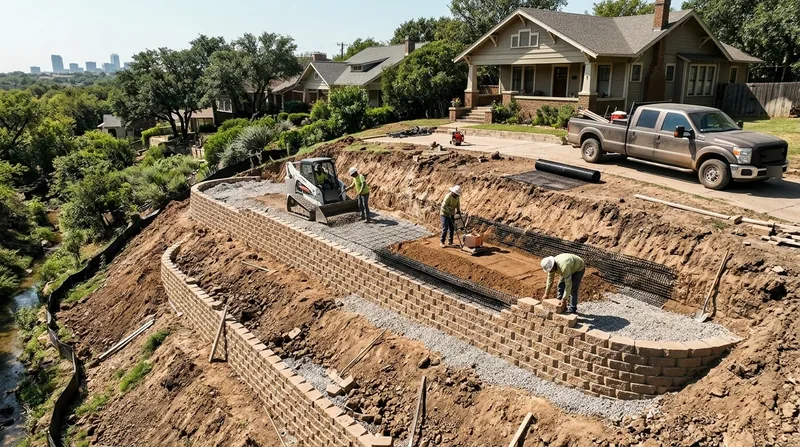




Slope Stabilization & Erosion Control in Fort Worth protects homes, driveways, and yards from the relentless forces that destabilize soil on creek banks, limestone bluffs, and cut-and-fill lots across the metroplex. Fort Worth's terrain breaks dramatically along the Clear Fork and West Fork, with many residential neighborhoods perched on ravine edges or built into sloping lots where black expansive clay shrinks in summer drought and swells violently after spring thunderstorms. Flash runoff, freeze-thaw cycles on north-facing slopes, and the weight of structures and driveways above unstable ground create failures that accelerate each year without intervention. We deploy terraced retaining walls, geogrid reinforcement, and engineered drainage to stop soil movement, prevent property loss, and restore usable yard space. This page explains what slope failure looks like in Fort Worth, how we stabilize slopes, and what to expect when you call for an estimate at (817) 764-1304.
Why Slope Stabilization Matters in Fort Worth: The Black Clay and Bluff Problem
Fort Worth sits on Cretaceous limestone and clay deposits that create unique challenges for homeowners. The black expansive clay that underlies much of the city shrinks dramatically during dry months, opening gaps between soil and wall footings. When spring rains arrive, that same clay swells, exerting lateral pressure that pushes walls outward and tilts them into dangerous lean. Homes built on bluffs overlooking the Trinity River, yards carved into creek-side ravines in Benbrook and Azle, and driveways supported on fill slopes all face this cycle year after year. Without proper slope stabilization, erosion accelerates, walls crack and fail, and property damage spreads upslope toward structures and utilities.
- Terraced retaining walls break long slopes into shorter, more stable segments that resist the pressure of swelling clay.
- Geogrid reinforcement anchors soil internally, doubling or tripling wall strength and reducing the risk of blowout or rotation.
- Subsurface and surface drainage systems remove water that triggers clay expansion and soil saturation.
- Proper wall height, footing depth, and backfill material ensure the wall can handle Fort Worth's freeze-thaw and wet-dry cycles for decades.
- Native plantings on stabilized slopes reduce runoff velocity and anchor soil with root systems adapted to North Texas clay.
A properly engineered slope stabilization system stops erosion, protects your home's foundation and basement from seepage, and restores confidence in your property's long-term value.
Key info: In Mistletoe Heights and Rivercrest, homes built on bluffs 40 to 60 feet above the Trinity River face catastrophic erosion if slopes fail. A leaning or bulging wall is an emergency. Call us immediately at (817) 764-1304 for same-day assessment. Permits may be required, and the Fort Worth Building Department must approve engineered designs for tall or tiered walls. Always check with your local jurisdiction before work begins.
For detailed guidance on retaining wall repair and leaning wall stabilization, see our dedicated repair service page.
How We Stabilize Slopes in Fort Worth: Our Process and Methods
Slope stabilization begins with a site inspection to measure slope angle, assess soil type, check drainage patterns, and identify structures or utilities that constrain design. We drill test holes, observe clay color and texture, and evaluate how water moves through and off the slope. From there, we design a tiered wall system with proper footing depth, geogrid layers, and drainage infrastructure. Installation follows a strict sequence: we clear and compact the building pad, set the footing below frost line (typically 12 to 18 inches in Fort Worth), build the wall face, place geogrid and backfill in lifts, and install drainage pipe and swales to manage surface and subsurface water. Every wall is built to withstand the surcharge of soil above it, the lateral pressure of swelling clay, and the dynamic loads of freeze-thaw and heavy rain.
- We excavate the slope to the proper angle and compact the base using a plate compactor or vibratory equipment.
- We set a reinforced concrete or engineered block footing below the frost line with proper drainage stone underneath.
- We build the wall face course by course, checking level and batter (backward lean) at every lift to ensure proper geometry.
- We place geogrid layers horizontally at specified intervals, extending each layer into the retained soil behind the wall.
- We backfill in 12-inch lifts with approved material, compacting each lift to at least 95 percent Standard Proctor density.
- We install perforated drainage pipe at the base of the wall and connect it to a daylight outlet or French drain system.
- We slope the grade away from the wall and plant stabilization vegetation to reduce runoff and anchor soil with roots.
This methodical approach ensures the wall performs for 30, 40, or 50 years without settling, leaning, or losing its bond to the slope above.
Example: A Tanglewood homeowner had a 25-foot slope behind her 1960s brick ranch, with a failing landscape timber retaining wall and a driveway at the top of the slope. We removed the old timber wall, terraced the slope with two tiers of segmental block walls, placed geogrid in each tier, and installed a perforated drain line to daylight at the downslope corner of the property. The driveway is now secure, water no longer pools behind the house, and the slope is stable through droughts and spring storms.
Learn more about block and segmental retaining walls and drainage systems that protect your property.
Slope Stabilization & Erosion Control Methods: Choosing the Right System
| Approach | Description | Best for |
|---|---|---|
| Single-tier segmental block wall | Modular interlocking blocks with geogrid, footing, and backfill drainage. Height typically 3 to 6 feet. | Moderate slopes, driveways, residential lots in Wedgwood, Ridglea, and newer subdivisions. |
| Multi-tiered terraced walls | Two or more wall tiers stacked with benches between them. Each tier independently drained and reinforced. | Steep creek-side slopes in Benbrook, Azle, and bluff properties along the Trinity River where single wall height exceeds 8 feet. |
| Poured concrete retaining wall | Monolithic reinforced concrete wall with integral footing and drainage provisions. Can be faced with stone or left exposed. | High-load applications (driveway surcharge, pool, large structure above), or where tall walls exceed code limits for segmental block. |
| Geogrid-reinforced soil (GRS) slope | Engineered soil layers with continuous geogrid reinforcement, often faced with erosion control fabric or coir logs. Gradual slope angle. | Large open properties, environmental sites, and situations where a traditional wall is not feasible or aesthetically appropriate. |
| Boulder and natural stone wall | Large limestone or granite boulders mortared and stacked with drainage and geogrid behind. Rustic appearance common in historic Fort Worth neighborhoods. | Fairmount, Ryan Place, and other 1910s-1920s Craftsman neighborhoods where period-appropriate stone matches existing landscape features. |
Slope Stabilization & Erosion Control Cost in Fort Worth: What to Expect
The cost of slope stabilization depends on slope length, height, soil type, drainage complexity, and whether you need engineered plans and permits. A simple single-tier wall 3 to 4 feet tall and 20 to 30 feet long may cost less than a steep multi-tiered system on a creek bank. Geogrid reinforcement, subsurface drainage, and site access all factor into the final price. We recommend getting a free estimate from us and at least one other qualified contractor so you can compare scope, materials, and timeline. Our pricing page provides ballpark figures for common scenarios, but every slope is different. Call (817) 764-1304 to schedule an on-site assessment, or submit photos and measurements online for an initial quote.
Factors that increase cost include: steep slope angle (more wall height or multiple tiers), poor drainage conditions (requiring additional perforated pipe and daylight outlets), clay or unstable soils (requiring deeper footings or thicker geogrid), proximity to structures or utilities (requiring careful excavation and protection), and engineered design (required by code for walls over 4 feet or supporting a surcharge). Factors that reduce cost include: shorter walls, stable granular soils, good site access, and a slope that can accommodate a gentler angle with less wall height. A terraced system often costs more upfront than a single tall wall, but it performs better in Fort Worth's clay and reduces the risk of catastrophic failure.
Visit our full pricing overview for detailed breakdowns by wall type and height. Remember that the cheapest estimate is not always the best value. Choose a licensed, insured contractor who inspects the site, explains the design, and stands behind the work with a warranty.
Slope Stabilization & Erosion Control Near Me: What to Look for When Hiring a Fort Worth Contractor
When you search for slope stabilization and erosion control near you in Fort Worth or surrounding areas, you want a contractor who understands Fort Worth's clay soils, bluff topography, and drainage challenges. Start by verifying that the contractor is licensed and insured. Request references from recent projects in your neighborhood or on similar terrain, and call those references to ask about wall performance, drainage function, and how the contractor handled unexpected site conditions. Understand whether your project requires a building permit (the Fort Worth Building Department requires permits for walls over approximately 4 feet or when a wall supports a surcharge such as a driveway or structure). A reputable contractor will check with the local building department, pull permits if required, and provide you with a detailed scope of work that includes materials, drainage specifications, and geogrid reinforcement details.
- Ask for at least three references from similar projects completed in the past 12 to 24 months.
- Confirm that the contractor will obtain a permit from the Fort Worth Building Department or relevant local jurisdiction if required by code.
- Request a written scope of work that specifies wall height, geogrid layers, drainage details, backfill material, and timeline.
- Check whether your HOA or neighborhood association has restrictions on wall materials, height, or appearance, and ensure the contractor respects those rules.
- Ask about warranty coverage for the wall structure, drainage system, and any plantings or erosion control measures.
A thorough estimate process protects both you and the contractor by setting clear expectations before work begins.
Contact us at (817) 764-1304 or visit our contact page to request a free, no-obligation estimate. We inspect every site in person, explain our design approach, and answer your questions about permits, materials, and timeline before you commit to the project.
Slope Stabilization & Erosion Control in Fort Worth: Pricing Guide
| Service | Price | Details |
|---|---|---|
| Single-tier segmental block wall, 3-4 feet high | Starting at $85-120 per linear foot | Includes footing, geogrid reinforcement, backfill, and basic drainage. Price varies with soil conditions and site access |
| Multi-tiered terraced wall system | Starting at $110-160 per linear foot per tier | Each tier independently footed and drained. Total cost depends on number of tiers, slope length, and drainage complexity |
| Poured concrete retaining wall | Starting at $120-180 per linear foot | Monolithic reinforced concrete with integral footing. Cost increases with height, driveway surcharge, or decorative facing |
| Geogrid-reinforced soil slope with erosion control | On estimate | Large-scale projects require site inspection to determine slope angle, area, soil type, and drainage outlet feasibility |
| Free estimate and consultation | Free | On-site inspection, soil assessment, drainage evaluation, and written quote within 24 hours. No obligation to book |
Indicative pricing, the exact cost depends on square footage, finish, and site access. Free personalized estimate within 24h at (817) 764-1304.


