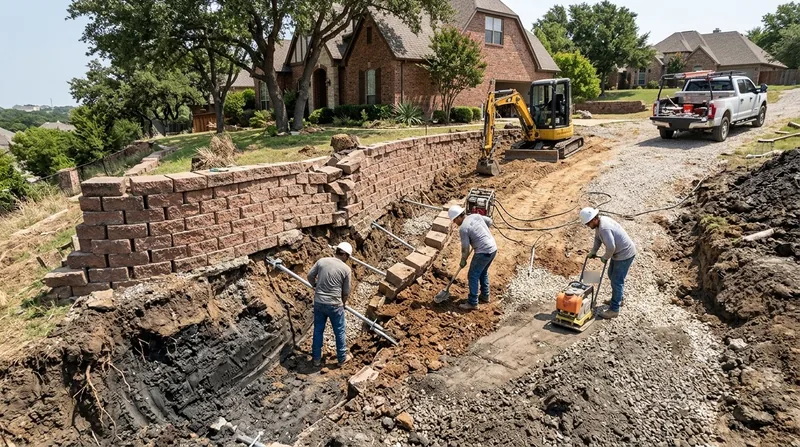




Leaning & Collapsed Wall Repair in Fort Worth is not a cosmetic fix, it is a structural emergency. Fort Worth sits on black expansive clay that swells after spring thunderstorms and shrinks hard under summer drought. Walls built on this soil face hydrostatic pressure from saturated clay, and many yards sit in creek ravines or on limestone bluffs where runoff compounds the problem. Retaining walls in Mistletoe Heights, Rivercrest, Tanglewood, and older neighborhoods like Fairmount are failing at an accelerating rate: concrete blocks bulge outward, poured concrete walls crack and tilt, and railroad ties from the 1970s and 80s collapse entirely. When a wall leans, bulges, or shows visible settlement, the soil is moving, and the wall is losing its battle. We respond fast with stabilization, drainage correction, and full rebuilds when necessary. Call us at (817) 764-1304 for immediate assessment.
Why Leaning and Collapsed Walls Fail Fast in Fort Worth
Fort Worth's black clay is the root cause of most retaining wall failure. This soil expands when wet and contracts sharply when dry, creating cycles of pressure that push walls outward. Drainage failures make this worse: if water pools behind a wall instead of flowing away, hydrostatic pressure builds against the back face and the wall cannot hold. Older walls, especially those made of timber, railroad ties, or single-wythe block, were often built without proper drainage systems or footings deep enough to resist clay movement. When a wall starts to lean, the problem accelerates because soil continues to shift and water continues to accumulate.
- Black expansive clay swells after heavy rain and shrinks in drought, pushing walls outward with thousands of pounds of force.
- Missing or failed drainage behind the wall allows water to build hydrostatic pressure that overwhelms the wall structure.
- Shallow footings or poor compaction mean the wall settles unevenly and loses vertical alignment.
- Older timber, railroad tie, and single-wythe block walls lack the mass and reinforcement to resist clay pressure long-term.
- Roots from trees or shrubs can penetrate the soil behind a wall and destabilize the backfill.
These failures create safety hazards and property damage that worsen rapidly if left unaddressed.
Key info: Fort Worth building codes require permits for retaining walls higher than roughly 4 feet measured from footing, or when a wall supports a surcharge such as a driveway. Engineered drawings may be required for tall or tiered walls. Always verify current thresholds and setback rules with the City of Fort Worth Building Permits office before work begins, as requirements vary by neighborhood and zoning.
For more on how drainage failures compound wall problems, see our retaining wall drainage service page.
How We Stabilize and Repair Leaning Walls in Fort Worth
Our repair strategy depends on how far the wall has moved and whether it can be saved or must be rebuilt. For walls that are leaning but still structurally sound, we install tieback anchors that thread into stable soil behind the wall and pull it back to vertical. We also excavate and replace the drainage system behind the wall to stop hydrostatic pressure from building again. For walls that are severely bulged, cracked, or partially collapsed, we remove the failed section and rebuild it with proper footing depth, compaction, and drainage. Every repair includes site assessment, soil testing if needed, and a clear explanation of why the wall failed and how we are preventing it from happening again.
- We inspect the wall on site, measure the lean or bulge, and assess soil conditions and drainage behind the wall.
- We determine whether the wall can be anchored and drained or must be partially or fully rebuilt.
- We obtain any required permits from the City of Fort Worth and confirm setback and property-line compliance.
- We install tieback anchors or remove and rebuild the wall, depending on the repair method chosen.
- We install or repair drainage, compact backfill to spec, and restore the yard.
- We walk you through the work, explain what we found, and provide long-term care guidance.
The entire process is transparent and takes one to three weeks depending on wall size and site access.
Example: A Mistletoe Heights homeowner noticed their 8-foot poured concrete wall leaning 3 inches at the top. We installed six tieback anchors, excavated 4 feet behind the wall to replace the failed drainage, and compacted new backfill. The wall returned to plumb, and the homeowner now has a functioning drainage system that will prevent future failure. Total time: 10 days.
For more on retaining wall repair options, visit our retaining wall repair service page.
| Approach | Description | Best for |
|---|---|---|
| Tieback Anchors | Steel rods or cables anchored into stable soil behind the wall, pulling it back to vertical. | Walls leaning less than 4 inches with sound concrete or block structure. |
| Drainage Replacement | Remove failed or missing drain, install perforated pipe and gravel behind wall to direct water away from soil. | Any wall showing signs of hydrostatic pressure or water pooling at base. |
| Partial Rebuild | Remove the top 3 to 6 feet of failed wall, rebuild on new footing with proper compaction and drainage. | Walls with severe bulge or cracking in upper section, foundation still sound. |
| Full Replacement | Remove entire wall, excavate to stable soil, rebuild from footing up with engineered design and drainage. | Walls that have collapsed, have failed footing, or are taller than 4 feet and require permit. |
Leaning & Collapsed Wall Repair Cost in Fort Worth: What to Expect
Leaning wall repair in Fort Worth starts at $2,500 for small walls under 20 linear feet that need drainage work and one or two tieback anchors. Most residential repairs fall between $3,500 and $8,000, depending on wall height, length, soil conditions, and whether the wall needs partial or full rebuilding. A full replacement of a collapsed 30-foot wall can run $12,000 to $20,000 or more. The single biggest cost driver is whether the wall can be saved with anchors and drainage (cheaper) or must be torn out and rebuilt (more expensive). Access to the site, proximity to structures or utilities, and whether the yard has mature trees also affect the final price.
We recommend getting two or three estimates from licensed contractors so you can compare approach and price. Many homeowners are surprised to learn that a professional repair now costs less than waiting for the wall to fail completely and damage a neighbor's property, a driveway, or a foundation. Our pricing page breaks down typical costs by repair type and wall size.
What to Look for When Hiring a Retaining Wall Contractor Near Me in Fort Worth
A leaning wall is a structural problem that demands a licensed, insured contractor with retaining wall experience, not a general handyman or landscaper. Many Fort Worth neighborhoods have HOA covenants that govern wall materials and height, so confirm your contractor understands those rules before work starts. If your wall is above 4 feet or supports a surcharge, your contractor must pull a permit from the City of Fort Worth. A contractor who skips the permit process is cutting corners and exposing you to liability and code violations.
- Ask for three references from retaining wall repairs completed in Fort Worth or nearby within the last two years.
- Confirm the contractor will pull a permit if the wall is over 4 feet or supports a surcharge such as a driveway.
- Get a written estimate that includes materials, labor, drainage, backfill, and cleanup, with no surprises at the end.
- Check whether your HOA or neighborhood has wall material or height restrictions and confirm your contractor will comply.
- Ask about warranty on the repair work and the drainage system installed.
The cheapest estimate is often not the best choice; choose a contractor who listens, explains the problem clearly, and stands behind their work. Contact us for a free estimate and we will walk you through the repair process step by step.
Leaning & Collapsed Wall Repair in Fort Worth: Pricing Guide
| Service | Price | Details |
|---|---|---|
| Tieback anchors and drainage repair | Starting at $2,500 | Small walls under 20 linear feet with minor lean, including two anchors and new perforated drain system. |
| Partial wall rebuild | Starting at $5,000 | Upper 3 to 6 feet of wall removed and rebuilt on existing footing with new drainage and compacted backfill. |
| Full wall replacement | Starting at $8,500 | Complete removal and rebuild from footing up, including soil prep, engineered design if required, and full drainage installation. |
| Emergency stabilization and shoring | On estimate | Urgent work to prevent collapse or property damage, including temporary bracing and priority scheduling within 24 hours. |
| Travel and site visit | Included | No mileage fee or travel charge for Fort Worth and all surrounding service areas within 30 miles. |
| Free estimate | No obligation | Same-day or next-day response at (817) 764-1304, on-site assessment, written quote with no pressure to book. |
Indicative pricing, the exact cost depends on square footage, finish, and site access. Free personalized estimate within 24h at (817) 764-1304.


