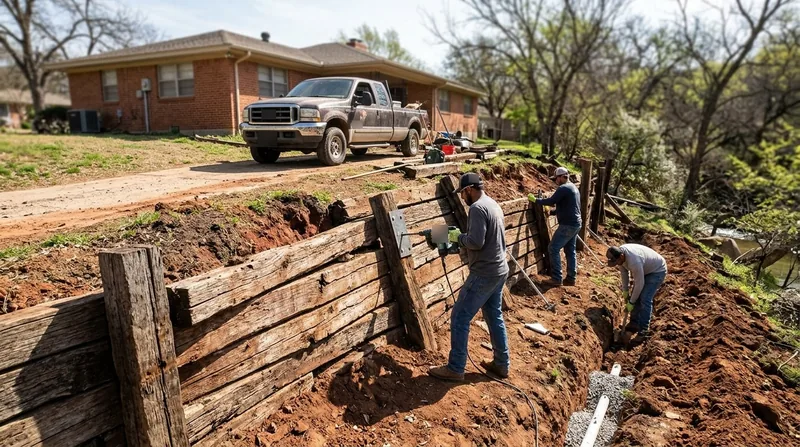




Retaining Wall Repair in Fort Worth stops walls from failing before they collapse into your yard, driveway, or foundation. Fort Worth sits on black expansive clay that shrinks hard in summer drought and swells violently after spring thunderstorms, pushing walls outward and cracking them from the inside out. Add flash runoff in creek-side yards along the Clear Fork and West Fork, limestone bluffs in Mistletoe Heights and Rivercrest, and decades of aging landscape timber and railroad tie beds from the 1970s and 1980s, and you have a recipe for leaning, bowing, and settling walls across Tanglewood, Ridglea, Wedgwood, and the older Craftsman neighborhoods of Fairmount and Ryan Place. When a wall starts to lean, bow, or crack, repair now is cheaper and faster than replacement later. We diagnose the root cause, fix drainage, install tieback anchors, or rebuild sections to stop failure in its tracks. Call us at (817) 764-1304 for a free estimate, or learn more about leaning and collapsed wall repair if your wall is already moving.
Why Retaining Wall Repair Matters in Fort Worth's Clay and Weather
Fort Worth's black clay is a two-edged sword. When it dries, it shrinks and pulls away from wall footings, breaking the seal and letting water seep behind the wall. When it rains, clay swells and pushes against the wall with tremendous force, especially if drainage is poor or nonexistent. A wall that looks solid one year may bow visibly the next after a wet spring. Cracks, leaning, and settling are not cosmetic problems in Fort Worth; they are early warnings that the wall is losing its grip on the soil.
- We identify whether the wall is failing due to poor drainage, clay pressure, or a weak footing, and we fix the actual cause, not just the symptom.
- We install tieback anchors, soil nails, or shotcrete reinforcement to stop a leaning wall without tearing it down.
- We rebuild damaged or settled sections while keeping the rest of the wall in place, cutting labor time and cost.
- We correct drainage behind the wall to prevent future swelling and pressure buildup.
- We verify that repair work meets Fort Worth and local building codes, including setback and property-line rules.
Catching a wall problem early saves thousands of dollars and protects your home, driveway, and landscape from catastrophic failure.
Key info: Fort Worth's building code requires a permit for retaining walls above roughly 4 feet measured from the footing, or when a wall supports a driveway or structure. Engineered drawings are often required for tall or tiered walls. Always check with the City of Fort Worth Development Services to confirm thresholds and requirements for your property before work begins.
How We Repair Retaining Walls in Fort Worth: A Step-by-Step Approach
Every wall failure in Fort Worth tells a story. We start by walking the wall, checking for cracks, bowing, settling, and water staining. We dig at the base to inspect the footing and see whether clay is pushing, water is pooling, or the wall is simply old and tired. We then recommend the repair method that stops the failure with the least disruption to your yard and wallet.
- We assess the wall's tilt, crack pattern, and soil conditions to determine whether it is failing from pressure, poor drainage, or structural weakness.
- We excavate behind the wall if needed to install or repair a drainage system, removing standing water and reducing soil pressure.
- We install tieback anchors or soil nails into stable soil behind the wall, anchoring it back and preventing further movement.
- We rebuild damaged or settled sections of the wall, matching existing materials and color when possible.
- We backfill with gravel and install or repair perforated drain pipe to keep water moving away from the wall face.
- We test the repair by observing the wall after the next rain cycle to confirm drainage is working and movement has stopped.
Most repairs in Fort Worth take one to three days, depending on wall length and the repair method chosen.
Real example: A Mistletoe Heights homeowner noticed a 12-foot cream limestone wall leaning into the yard after heavy spring rains. We dug behind the wall, found standing water and clay swelling, installed a perforated drain line, and anchored the wall back with three tieback anchors. The wall stopped moving within two weeks. Total time on site: two days. Cost was roughly half of a full replacement. For material-specific guidance, see our page on concrete retaining walls or block and segmental retaining walls.
Repair Methods: Which One Fits Your Wall?
| Approach | Description | Best for |
|---|---|---|
| Drainage Correction | Install or repair perforated drain pipe behind the wall, backfill with gravel, and regrade the surface to move water away from the wall face. | Walls leaning or bowing due to water pressure and poor drainage, no major cracks or settlement yet. |
| Tieback Anchors | Drill anchors deep into stable soil behind the wall and tie them back to the wall face with cables or rods, pulling the wall back into vertical. | Walls leaning outward, visible bowing, or active soil pressure, where demolition is not yet necessary. |
| Partial Rebuild | Remove and rebuild the damaged or settled section of the wall, installing a new footing, drainage, and backfill while leaving the sound portion standing. | Walls with localized failure, severe cracks, or settling in one section, when full replacement is not cost-effective. |
| Soil Stabilization | Inject grout or soil cement into the clay behind the wall to reduce swelling and improve bearing capacity, combined with drainage work. | Walls failing due to clay expansion and contraction, where anchors or rebuild is not practical. |
Each method is tailored to your wall's condition, soil type, and budget. We recommend the approach that offers the best long-term stability for your Fort Worth yard.
Retaining Wall Repair Cost in Fort Worth: What to Expect
Retaining wall repair cost in Fort Worth ranges widely depending on the wall's size, the repair method, and how much digging and rebuilding is needed. A simple drainage fix on a short wall may start around $1,500, while a tieback anchor repair on a longer wall or a partial rebuild can run $3,500 to $8,000 or more. The black clay, water pressure, and terrain features that define Fort Worth yards mean that most walls benefit from a combination of drainage and structural reinforcement, not just one fix alone.
Several factors push cost up or down. A wall in a tight backyard or next to a structure costs more to access and work on safely. A wall with multiple failure points (cracks, leaning, settling) needs more intervention than one with a single problem. A tall wall or one supporting a driveway may require engineered drawings and a permit, adding time and cost. We always provide a detailed estimate on site after inspecting the wall, the soil, and the drainage situation. Getting two or three estimates is smart; it helps you understand the scope and compare approaches. We are happy to explain why we recommend a particular method and what it includes. See our full pricing overview for more detail on common repair scenarios and what drives the numbers.
Retaining Wall Repair Near Me: What Fort Worth Homeowners Should Know When Hiring a Contractor
Choosing the right contractor for retaining wall repair is as important as choosing the repair method itself. A wall repair done poorly can fail again in a year or two, leaving you out of pocket and frustrated. A wall repaired well will hold for decades. Here is what to look for when you call a contractor near Fort Worth.
Licensed and Insured Status: Verify that any contractor you hire is licensed to perform structural work in Texas and carries liability insurance and workers' compensation. Ask for proof of insurance and a copy of their license. This protects you if someone is injured or if the work causes damage to your home or a neighbor's property.
Multiple Estimates: Call at least two or three contractors and ask them to visit your property. A good contractor will spend 20 to 30 minutes looking at the wall, asking about water flow, checking the footing, and understanding your concerns. If someone quotes you over the phone without seeing the wall, move on. Estimates should be written, detailed, and specific to your wall and soil type.
References and Reviews: Ask for the names and phone numbers of three recent customers in Fort Worth, Weatherford, Keller, or other nearby towns. Call them and ask whether the work was done on time, on budget, and whether the wall has held up since the repair. Online reviews on Google and the Better Business Bureau are also worth checking.
Permit Knowledge: A good contractor knows Fort Worth's building code and will tell you upfront whether a permit is needed for your wall repair. They will handle the permit application or help you understand what you need to do. Do not hire someone who says they can avoid the permit process; that is a red flag.
HOA and Property Line Awareness: If your home is in an HOA, ask whether the repair needs approval before work starts. If the wall is near a property line, a good contractor will verify setback distances and discuss any shared responsibility with a neighbor. This prevents disputes and legal headaches later.
Contact us for a free estimate and a detailed conversation about your wall's repair options. Call (817) 764-1304 or fill out our online form, and we will respond within 24 hours with no obligation to book.
Retaining Wall Repair in Fort Worth: Pricing Guide
| Service | Price | Details |
|---|---|---|
| Drainage Repair and Backfill | Starting at $1,500 | Perforated drain pipe installation, gravel backfill, and surface regrading to stop water pressure and minor leaning |
| Tieback Anchor Repair | Starting at $3,500 | Anchor drilling, cable or rod installation, and wall tie-back to correct bowing and restore vertical alignment on leaning walls |
| Partial Wall Rebuild | Starting at $5,000 | Removal and reconstruction of damaged or settled wall sections with new footing, drainage, and backfill, preserving sound portions |
| Engineered Repair or Complex Job | On estimate | Tall walls, tiered systems, or walls supporting structures require site inspection and engineer drawings before a firm price |
| Travel and Site Visit | Included | No separate charge for travel within Fort Worth and surrounding service areas, included in your free estimate |
| Free Estimate | No charge | Detailed site inspection, written quote, and repair recommendation within 24 hours, no obligation to proceed |
Indicative pricing, the exact cost depends on square footage, finish, and site access. Free personalized estimate within 24h at (817) 764-1304.


