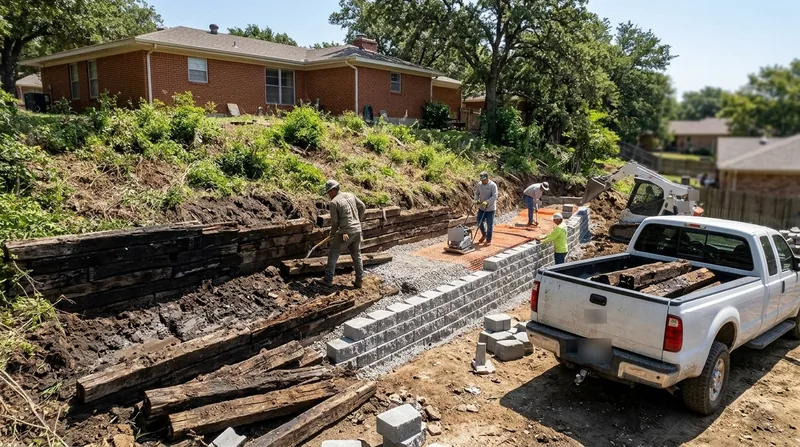




Railroad Tie Wall Replacement in Fort Worth tackles a widespread problem across the Metroplex: aging creosote-treated timber walls from the 1970s and 80s that are rotting, leaning, and failing on the black expansive clay that dominates residential lots from Fairmount to Tanglewood to the newer brick-and-stone subdivisions on the north and west edges. Fort Worth's extreme seasonal swings, intense summer heat, and spring thunderstorm runoff accelerate wood decay and soil movement beneath these landscape timber and railroad tie beds, leaving homeowners with sagging walls, pooling water, and collapsing edges. We remove the failed structure, haul away the treated timber, install proper gravel backfill and drainage, and rebuild the wall in durable block, poured concrete, or natural stone that will hold through another 30 years of Texas weather. Whether your wall sits on a creek bluff above the Clear Fork, in a ravine lot that catches flash runoff, or in a flat yard where clay heave is the enemy, railroad tie wall replacement stops the slide and restores your yard's stability and appearance. Call us at (817) 764-1304 for a free estimate, or visit our retaining wall replacement page to learn about other failed wall solutions.
Why Railroad Tie Walls Fail in Fort Worth's Climate and Soil
Creosote-treated railroad ties were a cheap, accessible retaining solution in the 70s and 80s, but they were never engineered for Fort Worth's black clay, flash-flood drainage patterns, and relentless summer sun. The wood absorbs moisture in spring storms, swells and lifts the wall, then shrinks and cracks in July and August drought, opening seams where water pools and accelerates rot. Meanwhile, the clay beneath expands and contracts with seasonal moisture, destabilizing the footing and pushing the wall forward. After 40 to 50 years, ties split, bolts rust, and the entire structure leans or collapses.
- Black expansive clay shrinks in summer drought and swells after spring thunderstorms, lifting and shifting timber footings.
- Creosote-treated wood absorbs water and rots from the inside out, especially in the bottom course where soil contact is constant.
- Ties rot faster in shaded creek-side yards and slower in full sun, but all fail eventually on this soil type.
- Leaning walls trap water behind them, accelerating interior decay and destabilizing the structure further.
- Ties were never bolted to resist lateral pressure, so they simply tip forward when the clay heaves.
Addressing a failing railroad tie wall before it collapses prevents costly emergency repairs, erosion damage to adjacent yards, and potential liability if the wall fails onto a neighbor's property or driveway.
Key info: Fort Worth's dominant failure mode is clay heave and wood rot, not erosion or hydrostatic pressure alone. A wall that leans is already failing internally. Waiting another season will make the job larger and more expensive. See Fort Worth Development Services for permit thresholds and setback rules that apply to your wall height and location.
How We Replace a Failed Railroad Tie Wall in Fort Worth
Replacement begins with a site visit to assess the wall's height, the soil and drainage behind it, proximity to structures or property lines, and whether your wall sits in a creek ravine or on a flat yard. We determine if a permit is required (most walls over 4 feet from footing need one, and we handle that process), then plan the new wall material and drainage. We remove the old ties, haul the creosote-treated timber responsibly, excavate and level the footing, install landscape fabric and compacted gravel base, then build the new wall in your chosen material. The entire process typically takes 3 to 7 days depending on wall length and height.
- We excavate the old footing and remove all failed timber and debris from the site.
- We install a compacted gravel base and landscape fabric to separate soil from the new structure.
- We build the new wall in segmental block, poured concrete, or stacked limestone based on your soil, budget, and aesthetic preference.
- We backfill with clean gravel and install proper drainage behind the wall to prevent water pooling.
- We grade and slope the yard to shed water away from the wall, protecting your new investment.
Each step is tailored to Fort Worth's clay soil and seasonal water movement. We also offer retaining wall drainage solutions if your site has chronic seepage or standing water issues.
Example: A homeowner in Mistletoe Heights had a 20-year-old railroad tie wall on a limestone bluff above the Trinity River. The wall leaned 6 inches forward, and water pooled behind it every spring. We removed the ties, installed a segmental block wall with a gravel and drain-pipe system, and regraded the yard to shed runoff toward the street. The job took 5 days, cost $8,400, and the wall is now stable and rated for 30+ years.
Railroad Tie Wall Replacement Methods and Materials
| Approach | Description | Best for |
|---|---|---|
| Segmental Block (SRW) | Modular concrete units, typically 12 inches wide and 6 inches tall, stacked and backfilled with gravel. Engineered systems are available for taller or steeper walls. Durable, cost-effective, and rated for 30+ years in Fort Worth clay. | Most residential replacements. Flat to gently rolling yards. Homeowners seeking durability and low maintenance. |
| Poured Concrete | Monolithic reinforced concrete wall, custom-formed and finished on-site. Offers superior strength and can be textured, stained, or left smooth. Higher cost but single-pour simplicity and no gaps. | Tall walls (over 6 feet). Walls supporting a driveway or structure. Homeowners who prefer a seamless, sculptural appearance. |
| Stacked Natural Stone | Cream chopped limestone or native limestone blocks, hand-fitted and mortared. Matches the aesthetic of existing limestone walls throughout Fort Worth's historic neighborhoods and bluff properties. | Historic homes in Fairmount, Ryan Place, Mistletoe Heights, Rivercrest. Bluff properties above the Trinity River. Homeowners seeking architectural continuity. |
| Timber (Non-Creosote) | Pressure-treated landscape timbers or composite lumber, properly anchored and backfilled. Not recommended as a long-term solution in Fort Worth clay due to eventual rot, but viable for low walls and short-term applications. | Temporary walls. Aesthetic preference for a rustic look. Homeowners willing to re-replace in 15 to 20 years. |
Railroad Tie Wall Replacement Cost in Fort Worth: What to Expect
The cost of replacing a failed railroad tie wall in Fort Worth starts at $35 per square foot for a basic segmental block wall on flat, accessible ground, and rises based on wall height, material choice, drainage complexity, and site access. A typical 30-foot-long, 4-foot-tall block wall costs between $4,200 and $6,000 installed. Poured concrete runs $45 to $60 per square foot, while natural stone runs $50 to $75 per square foot depending on the stone type and finish. Permitting, if required, adds $200 to $500 depending on the jurisdiction. The largest cost drivers are wall height (taller walls need more material and engineering), difficult site access (steep ravines or narrow driveways), and drainage complexity (if your yard has chronic water issues, a drain-pipe system adds $1,500 to $3,000).
Getting 2 to 3 estimates from licensed contractors is essential. Each site is different, and a contractor who visits in person will give you a more accurate number than a phone quote. Visit our pricing page for detailed breakdowns by wall type and height, or call (817) 764-1304 for a free, no-obligation estimate.
What to Look for When Hiring a Railroad Tie Wall Replacement Contractor Near Me in Fort Worth
Choosing the right contractor for railroad tie wall replacement is as important as the material itself. Fort Worth and surrounding areas are served by many landscape and hardscape companies, but not all have the structural knowledge, drainage expertise, or permitting experience that a failing wall demands. A qualified contractor will visit your site, assess the soil and drainage, explain permit requirements, provide a detailed written estimate, and carry liability and workers' compensation insurance. Ask for references from other Fort Worth homeowners, especially those with similar soil conditions or wall heights. Verify that the contractor is licensed by the State of Texas (check the Texas Department of Licensing and Regulation if you want confirmation), and request a copy of their insurance certificate before work begins.
- Ask whether the contractor handles permitting or if you need to pull the permit yourself, and understand the timeline.
- Request at least three references from Fort Worth homeowners with similar wall types or heights.
- Get a written estimate that breaks down material, labor, drainage, and any permitting or engineering fees.
- Check if your HOA or deed restrictions require approval for wall replacement, and verify setback and property-line rules with Fort Worth Development Services.
A contractor who takes time to explain the process, answers your questions clearly, and provides a realistic timeline and budget is worth the phone call. Contact us for a free estimate and a straightforward conversation about your wall.
Railroad Tie Wall Replacement in Fort Worth: Pricing Guide
| Service | Price | Details |
|---|---|---|
| Segmental Block Wall Replacement | Starting at $35/sq ft | Modular concrete blocks stacked and backfilled with gravel drainage. Cost increases with wall height, site access difficulty, and whether engineering drawings are required for walls over 4 feet. |
| Poured Concrete Wall Replacement | Starting at $45/sq ft | Reinforced monolithic concrete, custom-formed on-site. Price reflects material, formwork, reinforcement steel, and finish options such as texture or stain. Taller or engineered walls cost more. |
| Natural Stone Wall Replacement | Starting at $50/sq ft | Hand-fitted cream limestone or native stone blocks, mortared and finished. Cost varies by stone type, quarry availability, and labor for precision fitting and pointing in Fort Worth historic neighborhoods. |
| Drainage and Grading Upgrades | Add $1,500 to $3,000 | Landscape fabric, perforated drain pipe, and regrading to shed water away from the wall. Essential for yards with chronic seepage, creek-side lots, or clay heave issues. |
| Permit and Site Survey | Add $200 to $500 | Fort Worth Development Services permit fee, setback verification, and property-line confirmation. Required for most walls over 4 feet from footing or supporting a surcharge. |
| Free Estimate | No charge | Site visit, soil and drainage assessment, material recommendations, and written estimate provided within 24 hours. No obligation to book. Call (817) 764-1304. |
Indicative pricing, the exact cost depends on square footage, finish, and site access. Free personalized estimate within 24h at (817) 764-1304.


