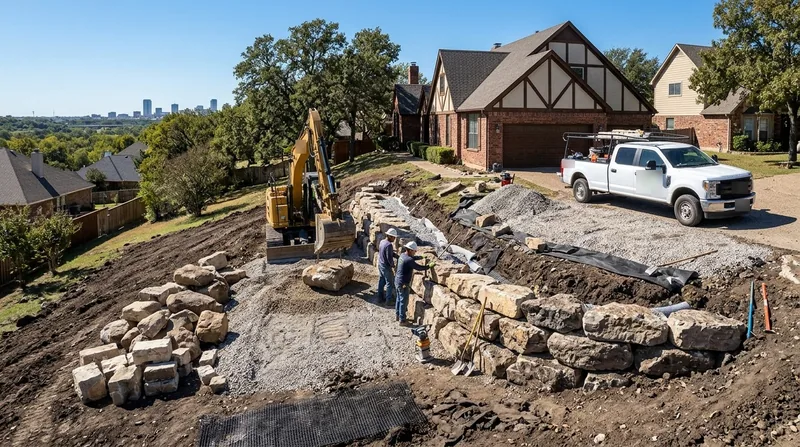




Boulder and natural stone retaining walls in Fort Worth blend seamlessly into the landscape while solving the real problem: Fort Worth's black expansive clay shrinks and swells with every drought and thunderstorm, and the Trinity River tributaries carve creek ravines and limestone bluffs through neighborhoods from Mistletoe Heights to Tanglewood. A properly built boulder or native limestone wall anchors sloped yards, prevents flash runoff damage, and looks like it belongs there, not like a concrete slab. We machine-place natural stone with engineered drainage and base preparation so your wall handles the seasonal clay movement and spring storms that collapse timber beds and sag CMU blocks across the city. Whether you're stabilizing a creek-side lot in Benbrook, tiering a north-side subdivision yard, or replacing a failed 1970s landscape timber wall, natural stone is the material that lasts through Fort Worth's heat and wet cycles.
Why Boulder and Natural Stone Walls Matter in Fort Worth's Shifting Clay Landscape
Fort Worth sits on black expansive clay that moves more than most homeowners realize. In summer drought, it shrinks and pulls away from foundations and walls. After spring thunderstorms and heavy rain, it swells and pushes outward with tremendous force. This cycle cracks poured concrete, tips CMU blocks, and snaps the landscape timbers that held up yards in the 1980s. A natural stone wall, when built with proper footing depth, base gravel, and drainage, actually works with the clay rather than fighting it. The weight and mass of stacked boulder distributes pressure evenly, and the drainage layer behind the wall prevents water from building up and pushing the wall forward.
- Natural stone distributes clay pressure more evenly than rigid concrete or block, reducing stress on footings during seasonal swelling.
- Proper drainage behind a stone wall prevents water saturation that triggers clay expansion and wall failure.
- Boulder and limestone walls age naturally and blend into creek ravines, bluffs, and sloped landscaping instead of looking like a barrier.
- Stone walls resist the UV damage and thermal cracking that affects concrete and timber under Fort Worth's hard, bright sun.
- A well-built stone wall handles the 4 to 6 inch grade changes common in creek-side lots from Azle to Cleburne without tipping or settling unevenly.
These qualities make natural stone the preferred choice for Fort Worth homeowners who want durability and a finished look that complements the landscape.
Key info: Fort Worth's building code requires a permit for retaining walls higher than roughly 4 feet measured from the footing, or when a wall supports a driveway or structure. Engineered drawings may be required for tall or tiered walls. Always verify setback and property-line rules with your local building department, as thresholds vary by jurisdiction. See the retaining wall installation guide for permit requirements in your area.
For more on how to stabilize slopes and control runoff, see our slope stabilization and erosion control service.
How We Build Boulder and Natural Stone Walls in Fort Worth
Building a natural stone wall that lasts means starting below grade. We excavate a footing trench deep enough to sit below the frost line and account for clay movement, compact the base, lay a gravel drainage layer, and then machine-place each boulder or native limestone stone so it seats firmly and leans slightly back into the slope. We don't stack loose rocks and hope. Every course is set for drainage and stability, and we backfill with gravel and filter fabric to manage water flow. The result is a wall that handles Fort Worth's clay cycles and heavy rain without settling, tilting, or failing.
- We excavate and compact a footing trench below the active clay zone to prevent seasonal movement from destabilizing the wall.
- We place a 4 to 6 inch gravel base and install filter fabric to allow water to drain away from the wall face and backfill.
- We machine-place each stone course with a slight backward lean and set each stone so it locks into the course below, creating a stable gravity structure.
- We backfill with drainage gravel and perforated drain pipe if the wall is taller than 4 feet or if the lot is prone to water pooling.
- We finish the top course flush or slightly rounded so water sheds away and doesn't collect on the wall surface.
This step-by-step approach ensures the wall performs through drought, flood, and the daily temperature swings Fort Worth experiences.
Local example: A homeowner in Ridglea with a sloping yard draining toward the house had an old CMU retaining wall that was leaning outward. We excavated behind it, found no drainage layer and clay pushing against the back of the wall. We removed the failed wall, dug a proper footing, installed gravel drainage and filter fabric, and rebuilt the wall with native limestone boulders. The new wall sits stable, water drains properly, and the yard looks like the landscape intended it that way. The entire job took five working days.
For detailed information on drainage solutions, see our retaining wall drainage service page.
Boulder and Natural Stone Wall Methods: Choosing the Right Approach for Your Fort Worth Yard
| Approach | Description | Best for |
|---|---|---|
| Machine-Placed Boulder Wall | Large native limestone or granite boulders set with a backhoe or excavator, proper footing, drainage, and backfill. Stones typically 1 to 3 tons each. | Taller walls (4+ feet), creek-side lots, high-clay areas, and yards where a natural, rustic finish is desired. Most common in Mistletoe Heights, Rivercrest, and Tanglewood. |
| Hand-Stacked Native Stone | Smaller stones (50 to 300 lbs) placed by hand with the same footing and drainage principles. Labor-intensive but allows precise, artistic stacking. | Shorter walls (2 to 4 feet), tight access, gardens, and properties where a detailed, hand-crafted appearance matters. Works well in Fairmount and Ryan Place bungalow yards. |
| Tiered Multi-Course Stone Wall | Multiple stone walls stacked at different elevations with terracing, each with its own footing and drainage. Creates planting pockets and visual interest. | Steep slopes, subdivisions with significant grade changes, and yards where landscaping and planting are part of the plan. Common on north-side developments. |
| Hybrid Boulder and Block Facing | Engineered segmental block wall with large boulders or stone veneer facing the upslope side, combining stability and finished appearance. | Tall walls (5+ feet) that need engineered design, properties near structures or property lines, and yards where both durability and appearance are critical. |
Boulder and Natural Stone Walls Cost in Fort Worth: What to Expect
Boulder and natural stone retaining walls in Fort Worth typically start at $25 per square foot of finished wall face, with most residential projects falling between $30 and $50 per square foot depending on stone size, footing depth, drainage complexity, and site access. A 20-foot-long wall standing 4 feet tall runs roughly 80 square feet of face, which puts the base cost in the $2,000 to $4,000 range before site prep, removal of failed walls, or engineered design. Larger projects, tall walls requiring engineered drawings, or yards with difficult access or heavy clay can push costs higher. Getting 2 to 3 estimates from licensed, insured contractors is the smart move, because each contractor will assess footing depth, drainage needs, and site conditions differently, and a low bid doesn't always mean a good value if the wall fails in five years.
Factors that move the cost up include:
- Wall height above 4 feet, which requires deeper footings, engineered design, and often a building permit.
- Removal and disposal of a failed or existing wall, which adds labor and hauling costs.
- Poor site access or tight yards that require hand-stacking instead of machine placement.
- Tiered or terraced walls that multiply the linear footage of footing and drainage required.
- Heavy clay or poor drainage conditions that demand thicker gravel bases and perforated drain pipe.
- Large, premium stone sourced from quarries rather than local suppliers, which increases material cost.
See our full pricing overview for detailed breakdowns and examples. Call us at (817) 764-1304 for a free, no-obligation estimate tailored to your site.
Boulder and Natural Stone Walls Near Me: What Fort Worth Homeowners Should Know When Hiring a Contractor
Hiring the right contractor for a boulder or natural stone wall is about more than price. You want someone who understands Fort Worth's clay, knows how to pull a permit, has the equipment and crew to do the work right, and can show you past projects that have held up through multiple seasons. A licensed and insured contractor carries general liability and workers compensation, which protects you if someone is injured on your property or if the work causes damage. Ask for references from at least two recent projects in your area, Keller, Southlake, Grapevine, or Hurst, and call those homeowners to ask how the wall has performed and whether the contractor showed up on time and cleaned up afterward.
- Verify that your contractor holds a current Texas general contractor or masonry license and carries liability insurance and workers compensation coverage.
- Ask whether the contractor will pull the building permit or advise you on permit requirements, since walls over 4 feet or supporting a driveway typically need approval from the local building department.
- Request references from completed projects in Fort Worth and surrounding cities, and follow up with those homeowners about durability and performance.
- Get a written estimate that includes footing depth, drainage details, stone type, and a timeline, so you know exactly what you are paying for.
- Check whether your HOA has restrictions on wall materials, height, or setbacks, and ensure your contractor is aware of those rules before work begins.
The right contractor will walk your property, discuss the clay and drainage challenges specific to your lot, and explain why the footing depth and drainage plan matter. A cheap estimate without those details is a red flag. Contact us at Fort Worth Retaining Wall for a free estimate and we will show you exactly what we propose and why.
Boulder & Natural Stone Walls in Fort Worth: Pricing Guide
| Service | Price | Details |
|---|---|---|
| Machine-placed boulder wall, standard footing and drainage | Starting at $25/sq ft | Finished wall face, 4-foot height or less, native limestone, proper gravel base and backfill included in Fort Worth |
| Hand-stacked or tiered stone wall with complex site conditions | Starting at $35/sq ft | Higher labor, tight access, multiple courses, or enhanced drainage. Footing and filter fabric included, site-specific challenges drive final cost |
| Engineered stone wall, tall or supporting structure | Starting at $45/sq ft | Walls over 5 feet, near property lines, or supporting driveway. Engineered drawings, deeper footing, perforated drain pipe, and permit coordination included |
| Removal of failed wall and rebuild with new stone | On estimate | Labor, hauling, and disposal of old material varies by wall size and condition. On-site assessment required to quote accurately |
| Travel within Fort Worth service area | Included | No separate mileage fee or travel charge for estimates or jobs in Fort Worth, Weatherford, Burleson, Mansfield, Keller, Southlake, and surrounding areas |
| Free estimate | No cost | Response within 24 hours at (817) 764-1304, includes site walk, discussion of options, and written proposal with no obligation to book |
Indicative pricing, the exact cost depends on square footage, finish, and site access. Free personalized estimate within 24h at (817) 764-1304.


