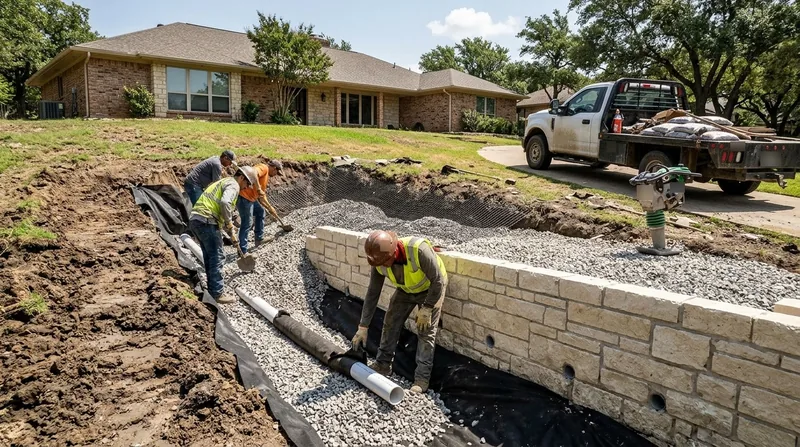




Retaining Wall Drainage in Fort Worth is the difference between a wall that lasts 20 years and one that fails in five. Fort Worth's black expansive clay shrinks during summer drought and swells after spring thunderstorms, putting immense hydrostatic pressure behind every retaining wall in the city. Whether your wall runs along a creek ravine in the bluffs above the Trinity River, borders a driveway in Tanglewood, or holds back a slope in Fairmount, water trapped behind it will push it forward, crack it, and eventually topple it. We install and repair drainage systems that relieve that pressure before it destroys your wall. Call us at (817) 764-1304 for a free estimate, or learn more about retaining wall repair in Fort Worth if your wall is already showing signs of failure.
Why Retaining Wall Drainage Fails in Fort Worth's Clay and Heat
Fort Worth sits on black expansive clay that is hostile to retaining walls. In summer, the clay dries and shrinks, creating voids behind the wall. When spring thunderstorms arrive, water fills those voids and builds up pressure that the wall cannot resist. Add the bright Texas sun, which accelerates evaporation and intensifies the shrink-swell cycle, and you have the perfect recipe for wall failure. A wall with poor or no drainage will bow, lean, crack, and eventually collapse. Even a well-built wall fails quickly without proper drainage because the pressure is relentless.
- Water trapped behind a wall creates hydrostatic pressure that pushes the wall forward and destabilizes its base.
- Fort Worth's clay expands when wet and contracts when dry, creating stress cycles that crack mortar and concrete.
- Walls built without weep holes, French drains, or gravel backfill fail within years, not decades.
- Drainage systems cost far less to install upfront than to repair or replace a failed wall.
Proper drainage is not optional in Fort Worth. It is the foundation of wall longevity.
Key info: A 20-foot segmental block wall in Rivercrest or Wedgwood without drainage can fail in 3 to 5 years. The same wall with a French drain and gravel backfill will perform for 30 years or more. The difference in initial cost is typically 15 to 25 percent.
For more information on preventing wall failure, see our guide to retaining wall installation in Fort Worth, which includes proper drainage from day one.
How We Install Retaining Wall Drainage Systems in Fort Worth
We approach drainage as a multi-layer system, not a single solution. Behind every wall we build or repair in Fort Worth, we install gravel backfill to allow water to flow freely, weep holes to release pressure, and often a French drain to capture and channel water away. The specific combination depends on the wall height, soil type, slope angle, and whether the wall supports a surcharge like a driveway or structure. We always evaluate site conditions before recommending a system.
- We excavate behind the wall and remove clay soil to a depth of 12 to 24 inches, depending on wall height and local conditions.
- We install a geotextile fabric to separate gravel from native clay and prevent soil migration into the drain layer.
- We place 4-inch diameter perforated PVC pipe at the base of the wall, sloped to daylight or a surface outlet.
- We backfill with clean gravel (typically 3/4-inch to 1.5-inch stone) to create a permeable zone that channels water into the drain pipe.
- We drill weep holes through the wall face, typically 1.5 to 2 inches in diameter, spaced 4 to 6 feet apart horizontally and 3 to 4 feet vertically.
- We cap the gravel with landscape fabric or filter cloth to prevent topsoil and mulch from washing into the drain layer.
This system works because water cannot build up. It flows down through gravel, into the drain pipe, and away from the wall.
Local example: A homeowner in Mistletoe Heights had a 15-year-old brick Tudor with a 12-foot timber retaining wall that was bowing inward. We removed the wall, installed a new concrete wall with a full French drain system, and the problem was solved. The wall now sheds water instead of absorbing it.
Learn more about our concrete retaining wall installation and how drainage is built into every project.
Retaining Wall Drainage Methods and When to Use Each
| Approach | Description | Best for |
|---|---|---|
| Weep Holes Only | Drilled or cast into the wall face at regular intervals to allow water to escape. Low cost, minimal disruption. | Existing walls under 8 feet with light surcharge; retrofit projects where excavation is difficult. |
| French Drain with Gravel | Perforated PVC pipe at wall base, surrounded by gravel and geotextile. Channels water downslope or to daylight. Industry standard for new construction. | New walls, tall walls (8+ feet), walls supporting driveways or structures, high-water-table areas. |
| Waterproofing Membrane | Liquid or sheet membrane applied to wall face to block water infiltration. Often combined with weep holes and drainage. | Walls in high-moisture areas, walls below grade, walls with no room for gravel backfill. |
| Subsurface Trench Drain | Underground drain trench that runs parallel to the wall and intercepts groundwater before it reaches the wall. Requires excavation upslope. | Properties with persistent groundwater, creek-adjacent walls, slopes with seasonal seepage. |
Most Fort Worth walls benefit from a combination approach: gravel backfill plus French drain plus weep holes. This redundancy ensures water finds an escape route no matter the season or weather pattern.
Retaining Wall Drainage Cost in Fort Worth: What to Expect
A complete retaining wall drainage system in Fort Worth starts at $2,500 for a simple retrofit (weep holes and minor gravel work on an existing wall). A new wall with full drainage built in (French drain, gravel backfill, geotextile, weep holes) typically costs $3,500 to $6,500 depending on wall length, height, and site access. Tall walls (12+ feet), walls supporting heavy surcharge, or walls in difficult-to-access locations cost more.
Several factors move the price up or down. Wall length is the primary driver, because a longer wall requires more drain pipe, more gravel, and more labor. Wall height matters because taller walls need deeper drainage systems and more weep holes. Site access affects cost significantly, because if we cannot bring a gravel truck close to the wall, we hand-carry materials and the labor time increases. Soil type and groundwater conditions also influence the system design. A wall in an area with seasonal creek seepage may need a subsurface trench drain in addition to standard backfill drainage.
We always recommend getting two or three estimates from licensed contractors. This protects you and helps you understand what is included at each price point. Some contractors quote only weep holes and call it drainage. Others include full French drain systems. Know what you are buying.
For a detailed pricing overview and to understand what factors affect your specific project, visit our pricing page.
Retaining Wall Drainage Near Me: What Fort Worth Homeowners Should Know When Hiring a Contractor
Hiring the right contractor for retaining wall drainage in Fort Worth starts with verification. Ask for a current Texas contractor license and proof of liability and workers compensation insurance. Call at least two references from recent drainage or retaining wall projects, and ask specifically about water performance during heavy rain. Do not hire a contractor who cannot provide references or insurance documentation.
Understand permitting requirements for your project. Many Fort Worth jurisdictions require a permit for walls above 4 feet measured from the footing, or when a wall supports a surcharge. Some require engineered drawings. Always defer to your local building department, because rules vary by neighborhood and zip code. A licensed contractor will know the rules for your address and will pull permits if required. If a contractor says permits are not necessary without checking with the city, that is a red flag.
Get the drainage plan in writing. Ask what system the contractor will install, where water will exit the site, and what maintenance (if any) will be required. Understand whether the quote includes a French drain, weep holes, gravel backfill, geotextile, and waterproofing. Do not accept vague language like "standard drainage." Specify exactly what you are paying for.
For questions or to schedule a free estimate, contact Fort Worth Retaining Wall at (817) 764-1304.
Retaining Wall Drainage in Fort Worth: Pricing Guide
| Service | Price | Details |
|---|---|---|
| Weep Hole Retrofit (Existing Wall) | Starting at $2,500 | Drilling and capping weep holes in existing wall, no excavation required. Price increases with wall length and access difficulty. |
| French Drain with Gravel Backfill (New Wall or Rebuild) | Starting at $3,500 | Complete drainage system including perforated pipe, geotextile, gravel, and weep holes. Cost depends on wall height, length, and site access. |
| Waterproofing Membrane Plus Drainage | Starting at $4,200 | Liquid or sheet membrane applied to wall face, combined with weep holes and gravel backfill. Used in high-moisture or below-grade conditions. |
| Subsurface Trench Drain (Upslope Water Interception) | Starting at $3,800 | Underground drain trench parallel to wall, for persistent groundwater or creek-adjacent properties. Price varies by trench length and depth. |
| Complex or Large-Scale Installation | On estimate | Tiered walls, tall walls over 12 feet, heavy surcharge, or difficult access require site evaluation before pricing. |
| Free Estimate and Site Visit | No charge | We respond within 24 hours at (817) 764-1304. No obligation to book. Estimate includes drainage recommendation for your soil and conditions. |
Indicative pricing, the exact cost depends on square footage, finish, and site access. Free personalized estimate within 24h at (817) 764-1304.


