Understanding Fort Worth's Unique Soil Challenges
Fort Worth sits on some of Texas's most problematic soil for retaining wall construction: expansive clay. This clay has a peculiar characteristic that frustrates homeowners and challenges even experienced builders. When the clay absorbs moisture, it expands significantly. When it dries out, it shrinks and pulls away from structures. This constant cycle of expansion and contraction creates enormous lateral pressure against retaining walls, far exceeding the forces that walls built in sandy or rocky soil must withstand.
Most homeowners don't realize that the soil conditions in their backyard are fundamentally different from those in other regions. Fort Worth's clay soil can exert pressures of 500 to 800 pounds per linear foot on a retaining wall, compared to just 300 to 400 pounds in more stable soils. This explains why a wall that seems perfectly fine one season can begin showing serious distress the next. The problem isn't always poor construction, though that certainly can be a factor. Often, it's simply that the soil itself is working against the structure from day one.
Why Retaining Walls Lean and Bow in Fort Worth Clay
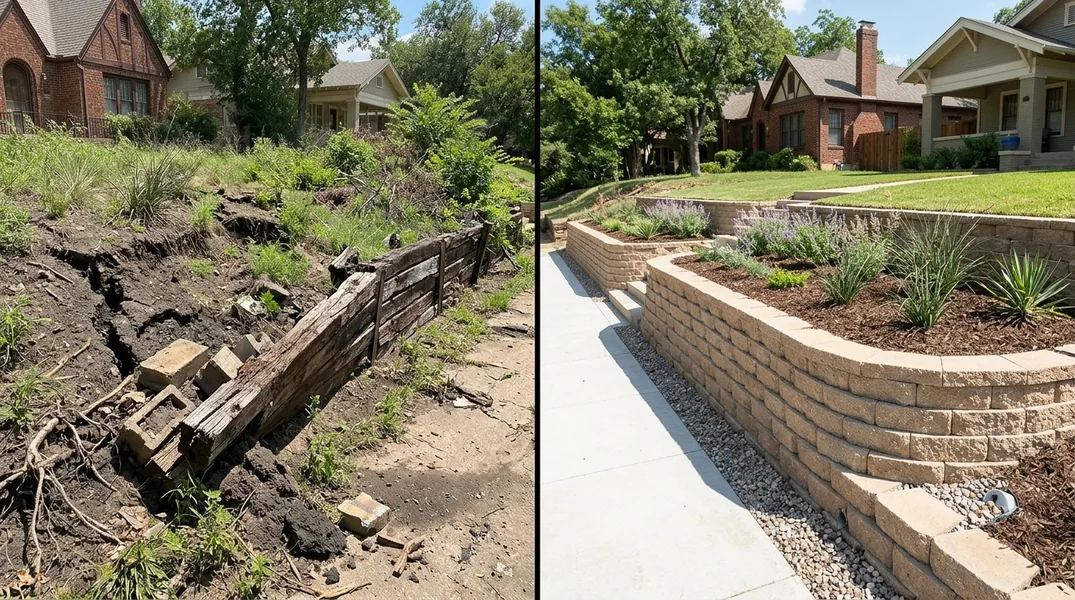
When you notice a leaning retaining wall on your property, you're witnessing the cumulative effect of soil pressure over time. The clay beneath and behind the wall is pushing outward with relentless force. Unlike a sudden structural failure, a leaning wall typically develops gradually. The wall may have been properly constructed, but the soil conditions eventually overwhelm the structure's ability to resist lateral movement. The wall begins to tilt away from the soil, and once this tilting starts, it tends to accelerate because the wall's weight distribution changes, creating even more stress on the foundation and base.
A bowing retaining wall is even more concerning than simple leaning. Bowing indicates that the wall is being pushed outward in the middle section, creating a curved or bulging appearance. This happens because the soil pressure is greatest at the base of the wall and continues pushing upward. In clay soil, bowing often develops after heavy rains when the clay absorbs moisture and expands, or during the dry season when differential settling occurs. The wall material itself, whether concrete, stone, or timber, simply cannot resist the force being applied. Without proper drainage and reinforcement, even the strongest materials will eventually bow under the relentless pressure of Fort Worth's clay.
Warning Signs Your Retaining Wall Is Failing
The first warning sign is usually visual: you notice the wall isn't standing perfectly vertical anymore. Step back and look at your retaining wall from a distance. Does it appear to lean away from the soil? Does the top of the wall seem to be moving outward relative to the base? These are red flags that should prompt immediate inspection. Another early warning sign is the appearance of cracks, particularly horizontal cracks running across the face of the wall. Vertical cracks can sometimes be minor, but horizontal cracks indicate that the wall is being pushed laterally and the material is failing under that pressure.
Water damage and drainage problems are also critical indicators of an impending failure. If you see water pooling behind the wall, seeping through the wall face, or notice that the soil behind the wall stays wet for extended periods, your wall's drainage system is compromised. Poor drainage accelerates the expansion of clay soil and increases the lateral pressure on the wall. Additionally, watch for sections of the wall that are separating or pulling away from adjacent sections. Gaps between wall segments indicate differential movement and suggest that failure is progressing. If you observe any of these signs, contact Fort Worth Retaining Wall for a free estimate to have your wall professionally evaluated.
The Role of Poor Drainage in Retaining Wall Failure
Many homeowners underestimate how critical proper drainage is to retaining wall longevity. In clay-heavy areas like Fort Worth, inadequate drainage is often the primary culprit behind wall failure. When water accumulates behind a retaining wall, it saturates the clay soil, causing it to expand dramatically. This expansion creates enormous pressure on the wall. Additionally, water can freeze in winter, and ice expansion further increases the force against the wall. Even in seasons without freezing, the constant presence of moisture in clay soil keeps it in an expanded state, maintaining maximum pressure on the wall structure.
Proper drainage solutions include installing a perforated drain pipe behind the wall, using a geotextile fabric to prevent soil from clogging the drainage system, and ensuring that surface water is diverted away from the wall. Gravel or crushed stone backfill also improves drainage compared to compacted clay. Unfortunately, many older retaining walls in the area were built without adequate drainage considerations. If your wall is showing signs of water damage or moisture problems, Retaining Wall Repair should include a comprehensive drainage assessment and upgrade.
Retaining Wall Repair Options for Fort Worth Properties
When a retaining wall begins to fail, you have several options depending on the severity of the damage. For minor leaning or bowing that hasn't progressed significantly, reinforcement techniques can sometimes stabilize the wall without complete removal. This might involve installing soil anchors, adding buttresses (supporting structures) to the back of the wall, or installing helical anchors that extend deep into stable soil. These solutions can be cost-effective if the wall's structural integrity is still reasonably sound. However, these repairs are only viable if the underlying problem, usually drainage, is also addressed.
In many cases, particularly with severely bowing or failing walls, Retaining Wall Replacement is the most practical and long-lasting solution. A new wall built with proper engineering for Fort Worth's clay soil, including adequate drainage, reinforcement, and appropriate materials, will perform far better than attempting to salvage a failing structure. Modern Concrete Retaining Walls can be designed with internal reinforcement and proper drainage systems that account for the unique challenges of clay soil. The investment in replacement is often recouped through decades of trouble-free performance.
When to Call a Professional Retaining Wall Contractor Near Me
If you've noticed any of the warning signs mentioned above, don't delay in getting professional help. Retaining wall failures can accelerate quickly, and a wall that appears to be leaning slightly today might be significantly compromised within months. Professional contractors have the expertise to assess whether your wall can be repaired or needs replacement, and they understand the specific soil and climate challenges of Fort Worth. They can also design solutions that will actually work in your local conditions, rather than applying generic retaining wall solutions that fail in clay soil.
Fort Worth Retaining Wall has extensive experience with clay soil failures and specializes in solutions that work in this challenging environment. Whether you need an inspection, repair, or replacement, calling (817) 764-1304 for a professional evaluation is the smart first step. Our team can assess your wall's condition, explain your options, and provide you with a clear picture of what's needed to fix the problem properly. Don't wait until your retaining wall fails completely and creates a safety hazard or property damage. Contact us today to protect your investment and your property.
Looking for a professional retaining wall contractor in Fort Worth? Fort Worth Retaining Wall responds fast for all your retaining wall needs.
Get a Free QuoteOur services: Retaining Wall Installation · Retaining Wall Repair · Retaining Wall Replacement